
Blazecut: how to put out a fire in a van
27 de junio de 2024
If we search online for ‘van fire’, we’ll find countless news articles about fires involving vans. This gives us an idea of just how easily an incident like this can occur.
We must therefore focus on this issue to try to prevent a tragedy like this from happening. I can’t imagine, after all the work (and money) that has gone into restoring it, a fire breaking out and completely destroying my van.
Table of contents
- Where can a fire break out in a van?
- Which fuel is more flammable, petrol or diesel?
- Is it compulsory to carry a fire extinguisher to put out a fire in a van?
- What should you do if a fire breaks out in a van?
- BlazeCut, automatic fire-extinguishing system
Where can a fire break out in a campervan?
I would highlight two possible locations where a fire could start in a campervan. One of these is the interior of the campervan. If the vehicle is fitted with electrical systems, gas and/or electronic devices, these could be the cause of a fire. The other critical area is the mechanical components, specifically the engine compartment. The engine involves the combustion of a highly flammable liquid; it is therefore a critical area where, in the event of leaks or faults, a fire could start.
Furthermore, in the T3 Syncro, the fuel tank is located at the rear, just in front of the engine; and, more specifically in petrol-engined models, the fuel lines run above it. This means that if these lines rupture – whether due to a pressure leak or a crack – petrol will fall directly onto the hot engine, making a fire highly likely.
Which fuel is more flammable, petrol or diesel?
The short answer to this question is that petrol is more flammable than diesel.
Petrol is a highly flammable fuel due to its low flash point and wide flammability range. It evaporates rapidly and emits highly flammable vapours, making it more likely to catch fire and explode under the right conditions.
On the other hand, diesel is less flammable than petrol. It has a higher flash point and is less volatile. Diesel requires a higher temperature to ignite and does not emit as many flammable vapours as petrol. This makes diesel less prone to accidental ignition and the rapid spread of fire.
This is why petrol vehicles are fitted with spark plugs which, with a single spark, are capable of igniting the fuel, whilst diesel vehicles require glow plugs to raise the fuel’s temperature and ensure it ignites.
In any case, both are fuels and so great care must be taken with both. A fire in a van must be avoided at all costs.
Is it compulsory to carry a fire extinguisher to put out a fire in a van?
You are not required to carry a fire extinguisher in your vehicle, except for those used to transport dangerous goods.
However, it is advisable to carry one, particularly in the event of a fire inside the van, as mentioned earlier. When the fire breaks out in the engine compartment, the situation is different.
What should you do if a fire breaks out in a van?
Carrying a standard fire extinguisher in the van may seem like a practical solution, but when it comes to putting out a fire in the engine compartment, several problems can and will arise.
- Reaction time: Spotting a fire in time can be difficult and, sometimes, it may be too late to take effective action. You might become aware of a fire in the engine through smoke coming out of the ventilation ducts or by the smell.
- Pulling over to a safe place: To use the fire extinguisher properly, you need to pull the van over to a safe place, which can take time and increase the risk of the fire spreading.
- Evacuating the vehicle and finding a safe place: If there is a fire in the engine compartment, it is essential that the van’s occupants leave the vehicle quickly and safely to take shelter away from the danger. If there are children amongst the occupants, this process may take even longer and require extra attention.
- Access to the engine compartment: Extinguishing a fire in the engine compartment requires opening the tailgate and removing all items from the boot, which takes up valuable time.
- Risk of fanning the flames: Opening the bonnet allows additional oxygen in, which could further fan the flames and increase the danger.
- Inefficient use of the fire extinguisher: In emergency situations, it is common for people to become nervous, which can result in the fire extinguisher being used inefficiently, wasting the extinguishing agent and failing to put out the fire.
Therefore, a fire extinguisher does not appear to be the most effective solution for putting out a fire in the engine compartment.
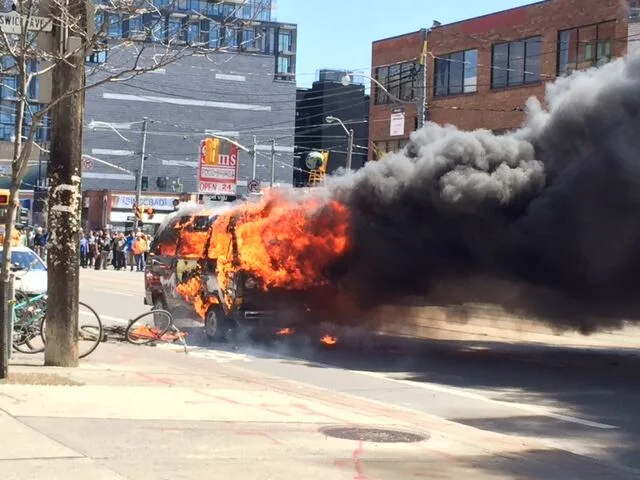
Take a look at an example of a fire in a Volkswagen T3 van:
The most effective solution is an automatic fire-extinguishing system called BlazeCut.
BlazeCut, automatic fire-extinguishing system
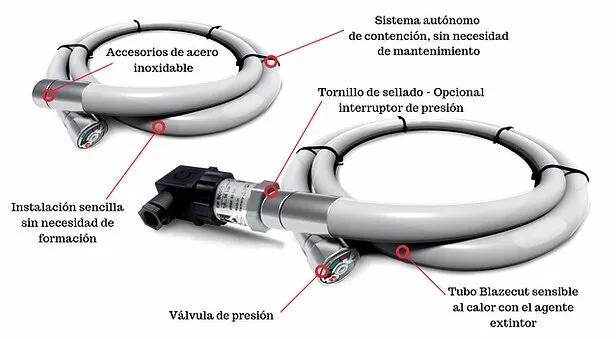
BlazeCut is a fire-extinguishing system designed to protect vehicles and confined spaces from potential fires. It consists of a highly flexible hose – which allows it to adapt to different spaces – containing the extinguishing agent inside. A gas known as HFC-227ea, which is safe and causes no damage to electrical or mechanical systems, nor to people present in the protected space. This ensures effective fire suppression without causing any additional negative consequences. Furthermore, it is classified to extinguish Class A, B and C fires, as well as electrical fires, making it suitable for protecting almost any type of space. Another feature of this gas is that it requires no regular maintenance and has a long service life of up to 10 years.
Its operation is based on a rise in temperature. Blazecut is activated when the temperature reaches 105°C, ensuring a rapid and effective response in the event of a fire. The rise in temperature causes the cylinder to rupture, releasing the extinguishing gas. Blazecut features a pressure gauge that allows its operational status to be checked. Furthermore, the system can operate in low-temperature conditions down to -40°C.
In summary, Blazecut is a highly efficient and versatile fire-extinguishing solution for protecting vans and other spaces from potential fires. Its compact design, automatic temperature-based activation and use of clean, effective extinguishing agents make it a reliable and cost-effective option. With Blazecut, you can rest assured that you have adequate fire protection to prevent your van – particularly the Volkswagen T3 Syncro – from suffering irreparable damage due to a fire.