
History of the VW T3 Syncro
Volkswagen T3 Syncro 4x4
The Volkswagen T3 van (known as the T25 in England and Ireland and the Vanagon in North and South America) is the third generation of the legendary Volkswagen Transporter. This third generation was produced in Germany from 1979 to 1992 and was the last to feature a rear-mounted engine.
The early models (1979–1982) were still air-cooled (like the T1 and T2), but from 1982 onwards they were fitted with water-cooled engines. These vans have rear-wheel drive.
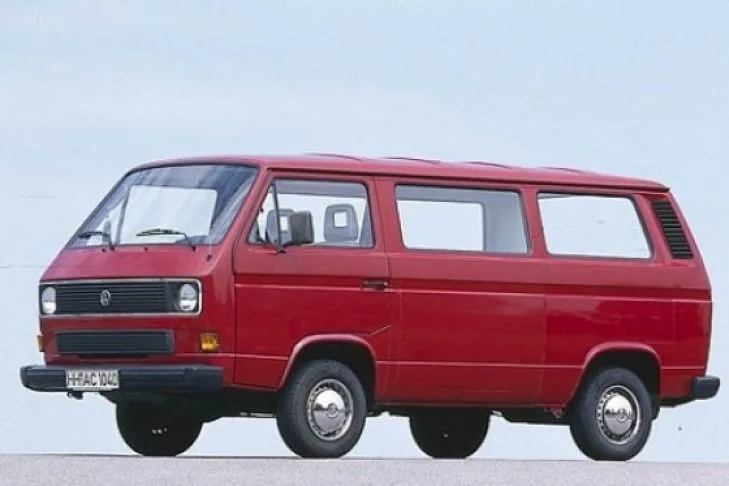
Like its predecessors, this model, with its rear-mounted engine, featured rear-wheel drive.
A bit of history
Volkswagen’s experience with 4×4 vehicles dates back to the Second World War with the creation of the Type 87 Kommandeurwagen and the Type 128 Schwimmwagen. But that was as far as it went until 40 years later. In fact, two names spring to mind when we think of Volkswagen all-wheel-drive vehicles.
One is Gustav Meyer (1925–2014), head of development for the Transporter; the other is Henning Duckstein, a VW engineer. In the 1970s, these two men began travelling through remote areas of Europe and Africa, where they realised that not just any vehicle would do for such locations. Until then, the off-road world had been dominated by Land Rovers or larger vehicles such as the Unimog. But they naturally set their sights on the T2. However, the socio-economic climate was not favourable, as this was a period of the oil crisis, redundancies and part-time work. This led them to start developing a series of prototypes, but in secret. Furthermore, as the project was confidential and they had no development budget, they had to resort to reusing parts from other models, such as the Beetle or the Iltis. The Baywindow 4WD was born.
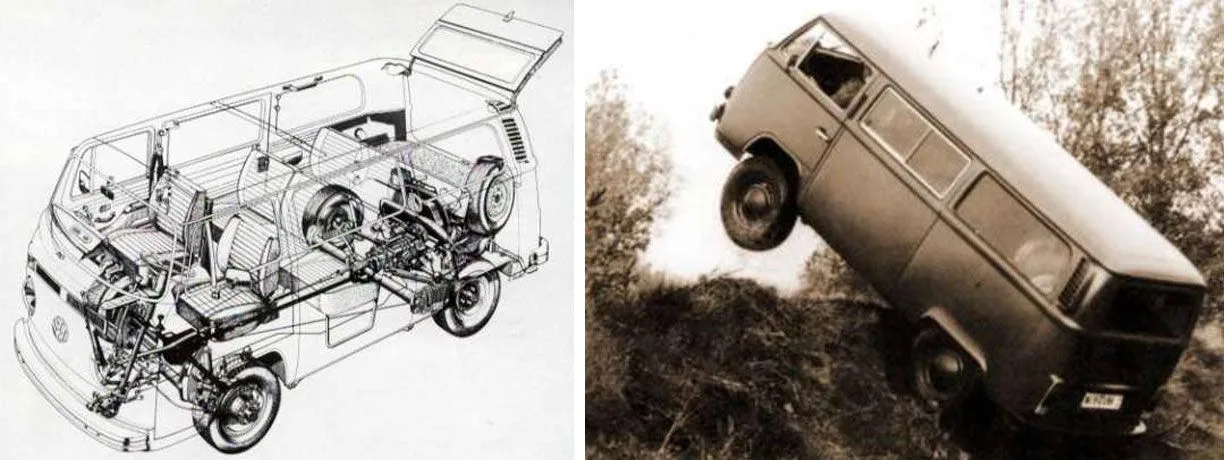
It was then that they pitched the idea to the marketing department, but they didn’t see its potential. They decided it was a project that wouldn’t work in terms of sales, so they turned it down.
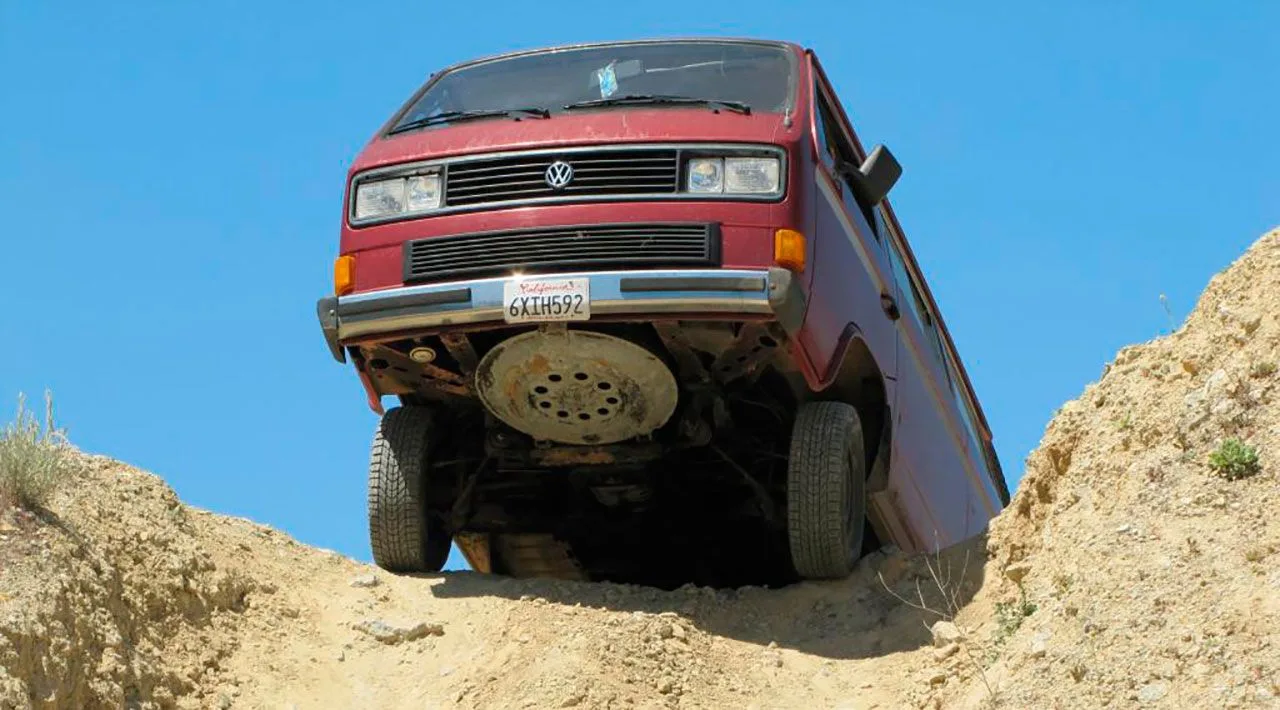
However, Henning and Gustav persisted and continued to develop the Bay Window 4WD project. Then, in 1983, with the launch of the T3 model, they re-evaluated the project and decided to apply the knowledge they’d gained to the T3 chassis. Things were starting to fall into place, and so in 1985 the project was given the green light and the dream became a reality with the start of production of the variant known as the T3 Syncro.
Steyr Daimler Puch AG, the partner
This chassis was fitted
with the first all-wheel-drive system (4WD or 4×4) developed by Volkswagen with the help of the Austrian firm Steyr Daimler Puch AG. These two companies reached an agreement because Steyr Daimler Puch had extensive experience in 4×4 development with its ‘Haflinger’ and the Mercedes ‘G-Wagen’. For its part, Volkswagen supplied the LT’s diesel engines for the ‘Pinzgauer’ 6×6.
The 4×4 drive system of the Volkswagen T3 Syncro is based on the Ferguson differential. This was a highly innovative system for its time, consisting of a viscous coupling that transmitted a variable amount of drive torque to the front axle depending on driving conditions, serving as a perfect substitute for an intermediate differential and capable of automatically producing a locking effect of almost 100 per cent.
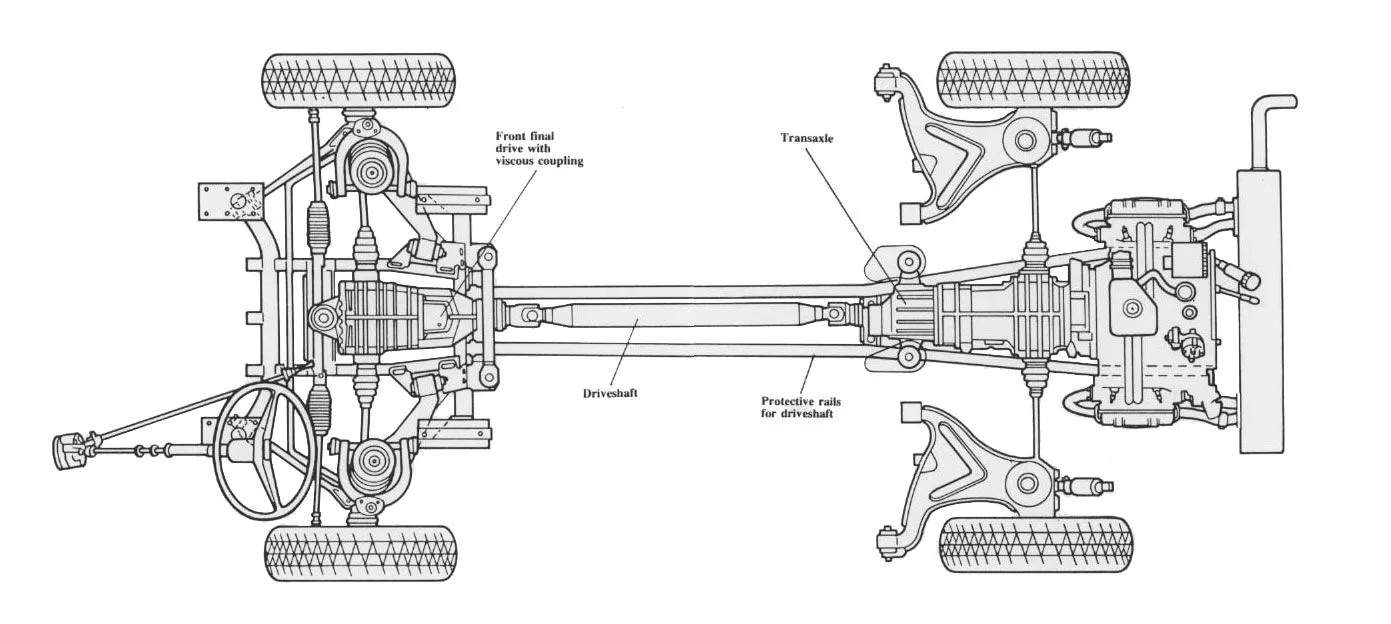
The Syncro variant was an expensive version, as the parts were manufactured in Hanover and final assembly took place in Graz (Austria) at the Steyr Daimler Puch AG plant. In fact, initially it was manufactured in Hanover, sent to Graz and then returned to Hanover to complete its assembly there once more.
Most Volkswagen T3 Syncro models were fitted with 14-inch wheels, but a small number left the factory with 16-inch wheels.
Production ceased in 1992, meaning they spent seven years on the production line.
An interesting fact: the Volkswagen T3 Syncro was not originally going to be called that; the name chosen was Volkswagen T3 Tetra. However, the similarity to milk cartons led to the name being changed at the last minute to Volkswagen T3 Syncro.
Differences between the VW T3 and the Volkswagen T3 Syncro
The Volkswagen T3 Syncro has specific features that set it apart from the VW T3 2WD:
- They have a 4-speed gearbox plus the so-called ‘G’ or ‘Gelande’ gear, an ultra-low range gear acting as a reduction gear
- The fuel tank is located at the rear, behind the engine. The 2WD models have it at the front. If the fuel filler cap is at the rear, it is a Syncro; if, on the other hand, the cap is located beneath the front passenger door, then it is a standard T3.
- Naturally, they are fitted with a cardan shaft and front differential as they are 4×4 vehicles.
- They have a rear differential lock and, depending on the specification, may also have a front differential lock.
- They are fitted with a viscous coupling inside the front differential.
Volkswagen T3 Syncro units manufactured
| Total units produced: | 43,468 |
| Units with left-hand drive: | 41,360 |
| Right-hand drive units: | 2,108 |
| Units with 14″ wheels | 41,330 |
| Units with 16″ wheels | 2,138 |
| Single-cab pick-up (245) | 1,787 |
| Double-cab pick-up (247) | 6,849 |
| Panel van (251) | 5,848 |
| Estate, Ambulance, Multivan (253) | 14,650 |
| Caravelle, Vanagon, Westfalia (255) | 14,334 |
How can you find out the year of manufacture?
If you’ve bought a second-hand Volkswagen T3 Syncro, you’ll want to check the exact year of manufacture using the chassis number. Once you’ve found the chassis number, look for the tenth digit, which will be a letter that, according to the table below, will tell you the year of manufacture.
| 10th digit | Model year | Manufacture dates | 10th digit | Model year | Manufacture dates |
|---|---|---|---|---|---|
| A | 1980 | 1 August 79 – 31 July 80 | H | 1987 | 1 August 1986 – 31 July 1987 |
| B | 1981 | 1 August 1980 – 31 July 1981 | J | 1988 | 1 August 87 – 31 July 88 |
| C | 1982 | 1 August 81 – 31 July 82 | K | 1989 | 1 August 88 – 31 July 89 |
| D | 1983 | 1 August 82 – 31 July 83 | L | 1990 | 1 August 89 – 31 July 90 |
| E | 1984 | 1 August 83 – 31 July 84 | M | 1991 | 1 August 1990 – 31 July 1991 |
| F | 1985 | 1 August 84 – 31 July 85 | N | 1992 | 1 August 91 – 31 July 92 |
| G | 1986 | 1 August 1985 – 31 July 1986 |
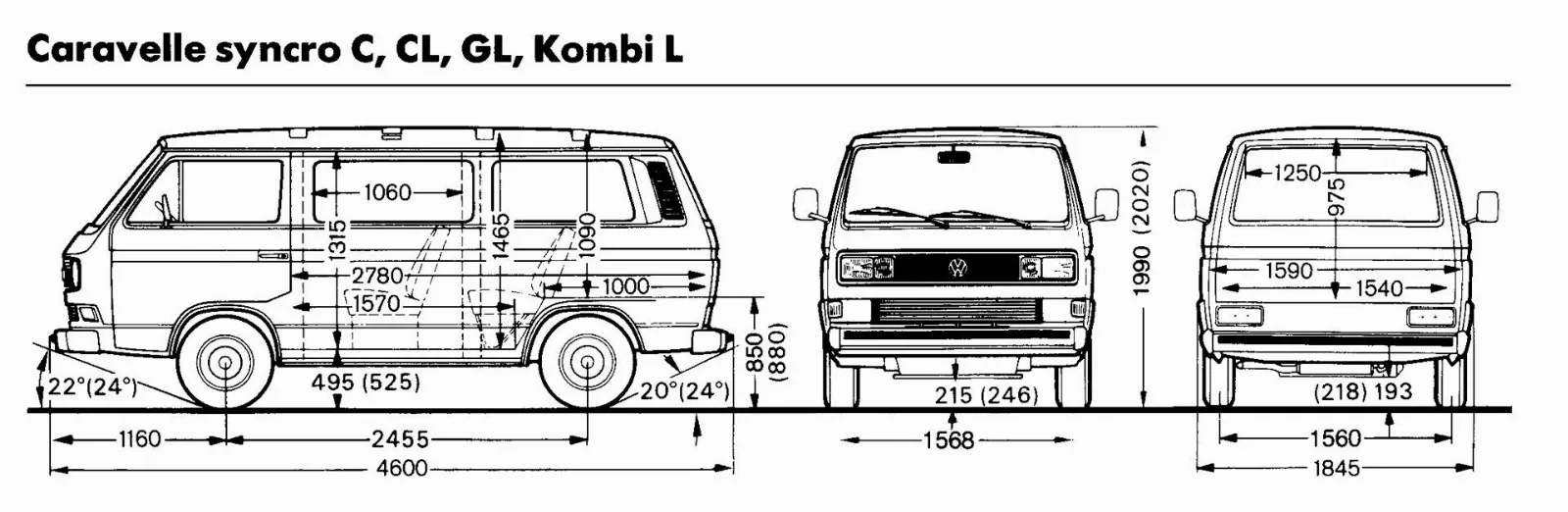
Dimensions of the Volkswagen T3 Syncro Caravelle
Model codes
| Code | Description | Code | Description |
|---|---|---|---|
| 245 | Single-cab pick-up, left-hand drive | 246 | RHD single-cab pick-up |
| 247 | Double-cab pick-up (LHD) | 248 | RHD double-cab pick-up |
| 251 | LHD panel van | 252 | RHD panel van |
| 253 | Kombi, Ambulance, Multivan (LHD) | 254 | Kombi, Ambulance, Multivan (RHD) |
| 255 | Caravelle, Vanagon, Westfalia etc. LHD | 256 | Caravelle, Vanagon, Westfalia etc. RHD |
Volkswagen T3 Colour Chart
Not sure what the colour code for your van is? It’s very simple: the colour code can be found on a silver plate under the driver’s seat, in the owner’s manual, or on a white sticker under the steering wheel.
The paint code consists of four characters, a combination of letters and numbers. They all begin with the letter L, which stands for ‘Laca’. The other three characters make up the colour code.
A compilation of videos about the Volkswagen T3 Syncro
Below is a playlist that gives you an idea of the capabilities and potential of this 4×4 van.
The best manual for the Volkswagen T3 Syncro
More information about this workshop manual
Finally, I’d recommend you visit the FAQs section on the Volkswagen T3 Syncro.
Are you looking for spare parts for your VW T3 Syncro?
A comprehensive catalogue of parts, accessories and manuals designed specifically for the Volkswagen T3 Syncro. Products selected with the ‘maker’ in mind.
Go to the T3 shop