
Oscar Kaiser, Syncro experiences in Australia
28 de marzo de 2019
Oscar Kaiser is launching a new section on the blog, and he’s my first guest. And who better than him, as he was the one who sold me the Syncro. Without further ado, I’ll leave you to the story he’d like to share with us. I hope you enjoy it.

I arrived in Australia to live there at the end of 2002, and it was clear that I wanted a vehicle so I could explore the Australian continent. What wasn’t quite clear to me, however, was what sort of vehicle I’d actually need, given the terrain and the vast distances across the country. One thing was certain: it had to be a 4×4.
Having previously owned a non-Syncro Westfalia Club Joker (which, incidentally, was stolen from me before I left Spain, ending up in Calpe in the hands of the local council, who found it and fraudulently attempted to re-register it without reporting it to the Civil Guard – but that’s a story for a whole other chapter), I fancied the idea of going for the T3 model again.
Imagine my disappointment when I discovered that those Westfalia vans never made it to Australia because, as they drive on the right-hand side there, the equipment couldn’t be fitted. In fact, there are very few T3s in Australia, and even fewer Syncros.
The turning point
After about six months of weighing up options like the Hilux, Mitsubishi and so on, one day whilst driving I spotted a white Syncro parked on the street.
I nearly crashed the car I was in, I was so stunned to see it. I stopped straight away and, luckily, the owner was having an ice cream with his daughter right next to it.
He was a German aeronautical engineer, roughly my age, who’d married an Australian woman and moved to Melbourne a few years earlier.
We started talking passionately about the T3s. Matthias Dinkelmeyer ended up becoming my best friend and tireless companion on wild adventures across Australia.
Thanks to that initial conversation, I began to understand the complexity of getting hold of a Syncro in Australia.
Let me explain: VW didn’t export to Australia in the 1980s due to the vast distance between Germany and Australia and the fact that it was very difficult to compete with the Japanese market, which, amongst other things, enjoyed preferential terms under trade agreements.
However, in 1987, TELSTRA (the Australian equivalent of Telefónica at the time) placed an order with VW for 100 Syncros to undertake the task of maintaining the lines in the Outback.
All 100 were fitted with a DJ engine and a rear differential. Transporter models with power steering, all white. Of those 100, 75 were panel vans and 25 were glazed vans. And of the glazed vans, 10 had double sliding doors.
I feared that these Syncros were possibly almost the only ones in the country.
I wondered where those vans might be all these years later, knowing that they’d officially been replaced by Hiluxes. And besides, would it be a good idea to buy a van that had been tinkered with by mechanics across half the Australian continent?
Things were already looking complicated.
The search and purchase
I set to work for what felt like endless weeks, poring over *The Trading Post* – a printed classifieds magazine for each city (I had to check the editions for Melbourne, Sydney, Brisbane, Canberra, Perth, Darwin and Adelaide) – and they began to appear sporadically…
Most read: VW Syncro EX-TELSTRA. 450,000 km or more, dented or modified (most with a Subaru engine or even one with an aviation Lycoming engine!)
. Until one day, a non-ExTelstra model turned up in Adelaide.
It belonged to an elderly gentleman who’d bought it to order from VW back in 1988.
It was a DJ model with twin differentials, power steering and a white paint finish.
He’d converted it into a campervan in an ingenious but rather rough-and-ready way compared to a Westfalia. They’d used it to travel around Australia during that time. His wife had recently passed away, which is why he was selling it for AU$20,000 with 260,000 km on the clock. It’s worth mentioning that 260,000 km is an extremely low mileage for any second-hand vehicle in Australia.
I saw the advert in the afternoon, rang the bloke that evening, and he told me that an Englishman from Perth had called him and was also interested, and that he might be flying over the next day to have a look at it.
I immediately looked for the earliest flight and saw that, flying from Melbourne, I’d arrive two hours before the bloke from Perth. Just in case, I bought a ticket and the next morning I was in Adelaide at 8 am.
I took a taxi from the airport. We met up next to the Botanical Gardens. After checking the van over, I decided to set off straight away for Melbourne via the A8, as it was going to be a long journey. Crossing the Little Desert was my first experience of feeling the van handle the sand and off-road terrain. It was absolutely brilliant.
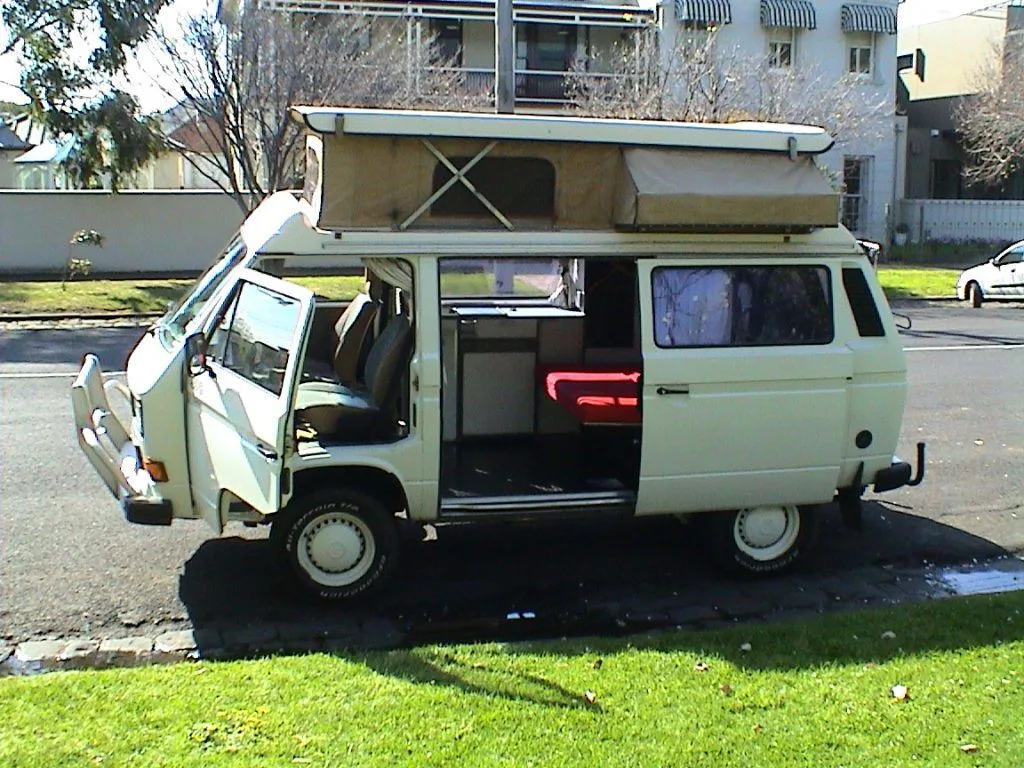
After 13 hours of non-stop driving – and driving on the left!!! – I arrived in Melbourne absolutely knackered but really excited about the adventures that lay ahead.
The interior was poorly designed, with a cupboard that even had a microwave!
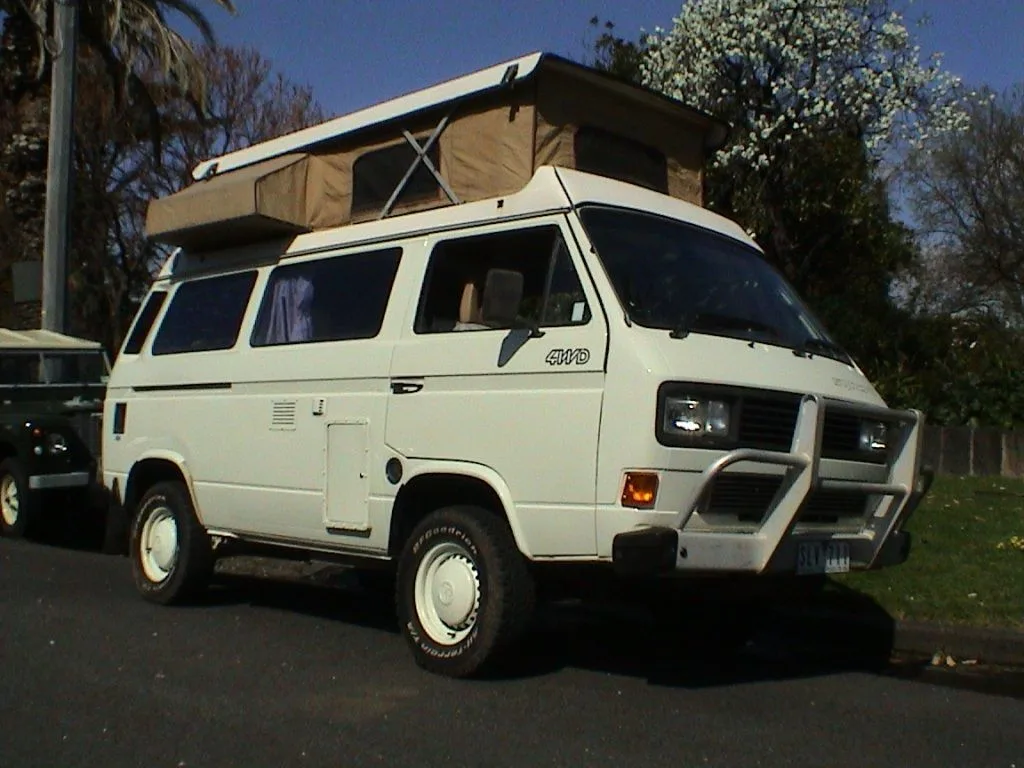
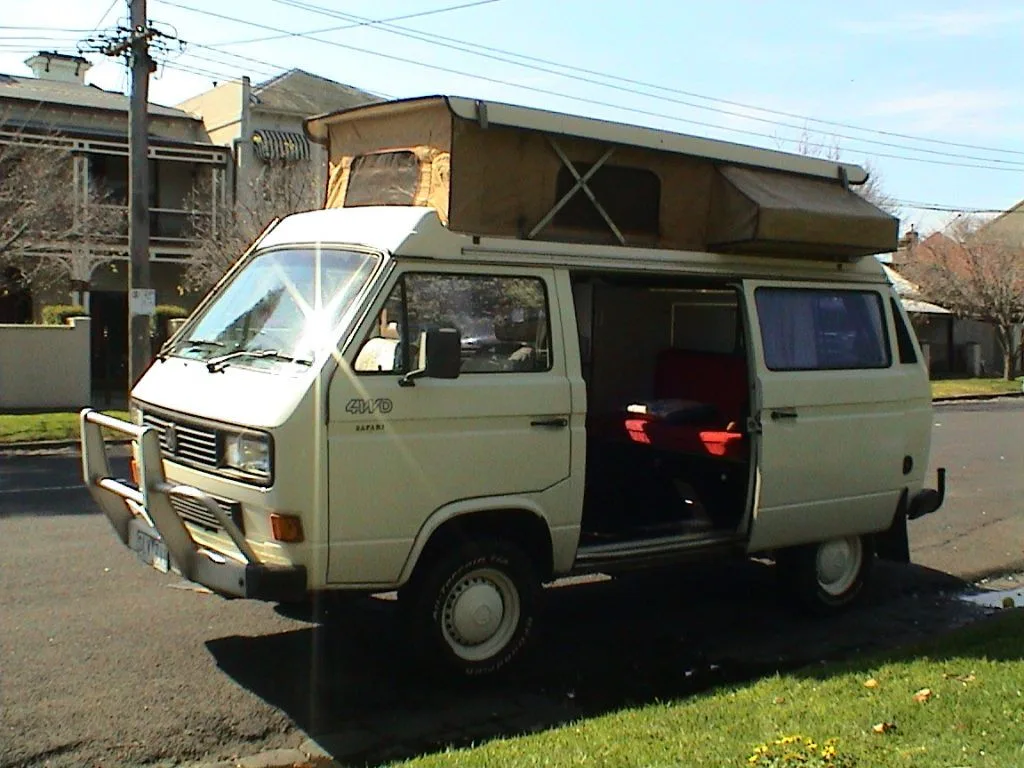
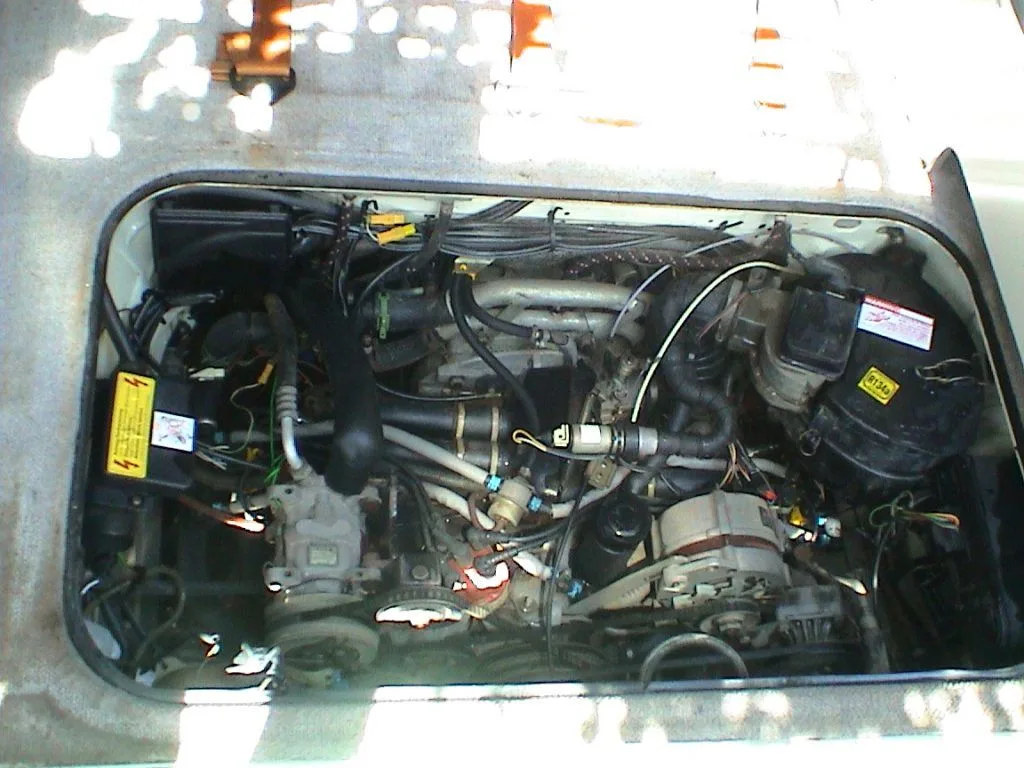
I started meeting up with Mattias to plan trips. First, I had to change the number plate from SA (South Australia) to Victoria, which involves a process similar to an MOT but more extensive.
The bloke who did it for me forgot to include a digit on the new paperwork, which made the registration process a bit of a faff. But a trip to the stationers’ and after trying a few pens… Voilà, problem sorted. 😀
Adding accessories
With that sorted, I set about looking for a BULL BAR. Those massive bumpers made of reinforced aluminium that all vehicles heading into the BUSH have fitted. They’re designed to protect against collisions with kangaroos*.
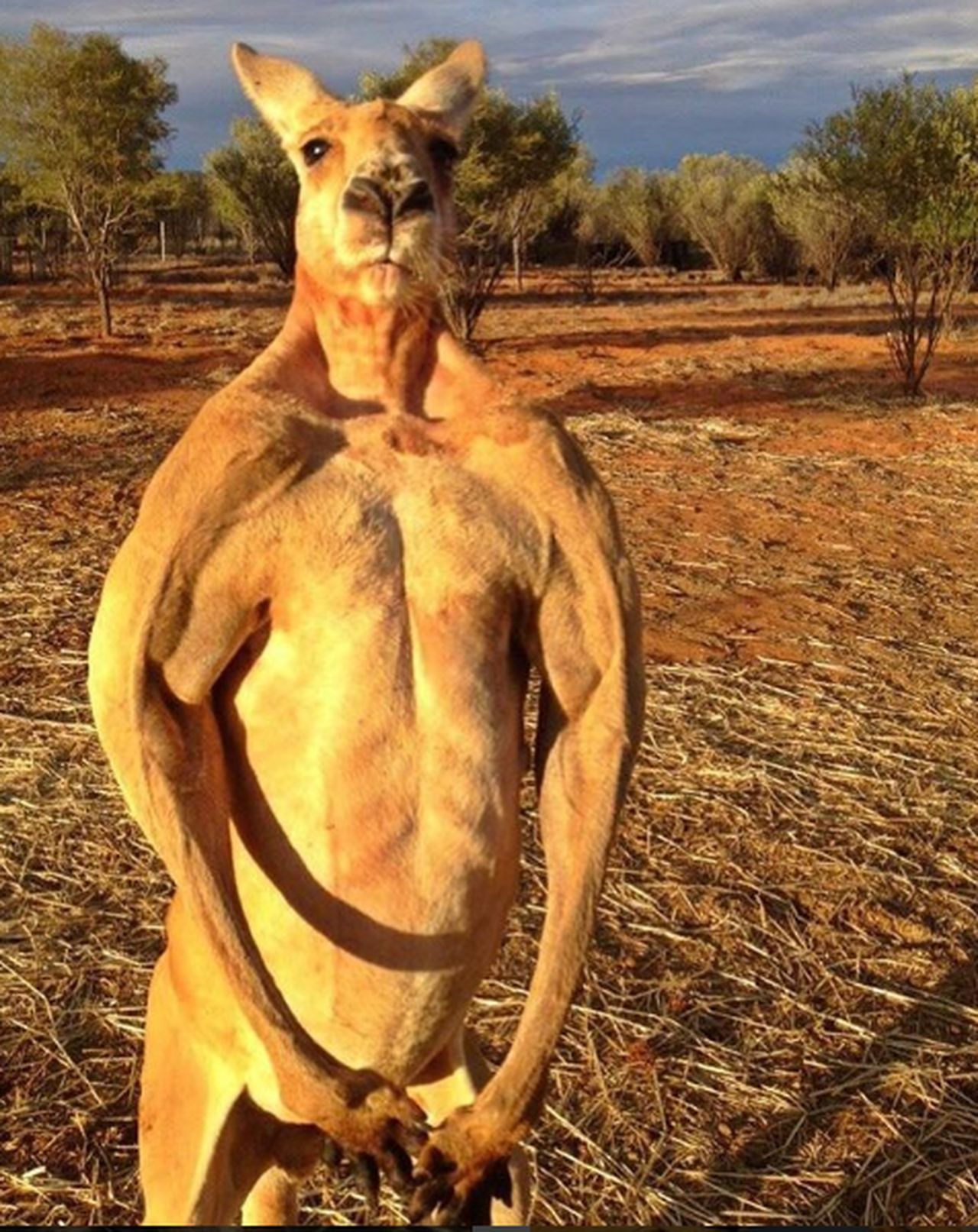
* Note: Red or grey kangaroos are enormous and can weigh up to 300 kg. When running, they can leap distances of around 5 metres and reach heights of up to 2 metres. They tend to move about at night.
So just imagine the worst-case scenario: in the middle of the night, driving at 100 km/h, you suddenly find 300 kg of pure muscle and bone in the air right in front of you, as if by magic.
Usually, the kangaroo crashes through the windscreen and out the rear, decapitating or snapping the necks of the car’s occupants. In the best-case scenario, you hit it on the ground. That’s where the bull bar is essential. The design ensures that, after the initial impact, the kangaroo is dragged under the vehicle, minimising the damage it might cause, particularly to the front end and, consequently, to the vehicle’s cooling system. It took me ages to find one for the van. I found one in WA, nearly 3,000 km away. They sent it to me and, once I’d fitted it, it was a whole different story!!!
I also decided to change the tyres. I fitted BF Goodrich AT 215/75-15, which is the most highly recommended tyre in those parts.
Adventures in Australia
Mattias and I started going out at the weekends. Because of the enormous distances involved, we’d set off first thing on Saturdays, around 6.00 am, to return, at best, on Sunday at midday or in the afternoon (in six years, I don’t think we ever managed to get back on time).
The idea was to explore nature reserves and abandoned forest tracks with a single motto: NEVER GO BACK THE WAY YOU CAME. Always forwards.
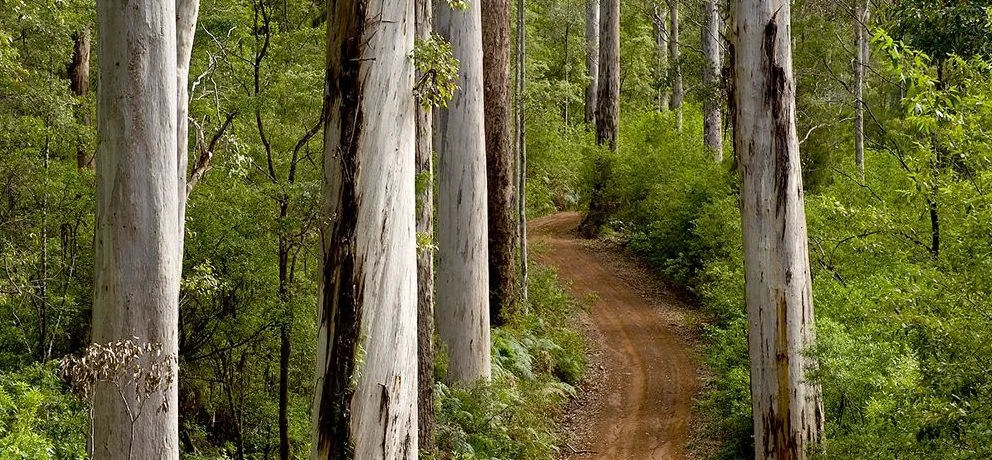
One of the first, most challenging and exciting trips was to the Otways/Angahook State Park, about 190 km away, in mid-autumn. A park that rises from sea level to peaks of 700 metres in less than 10 km!!!!
A vast, densely wooded natural park of rainforest where the ground is generally thick but permanently damp and sticky, with steep, deep valleys. A world away. To the south-west of Melbourne. We reached the edge of the park at 10 am. We deflated our tyres to 0.9!!!
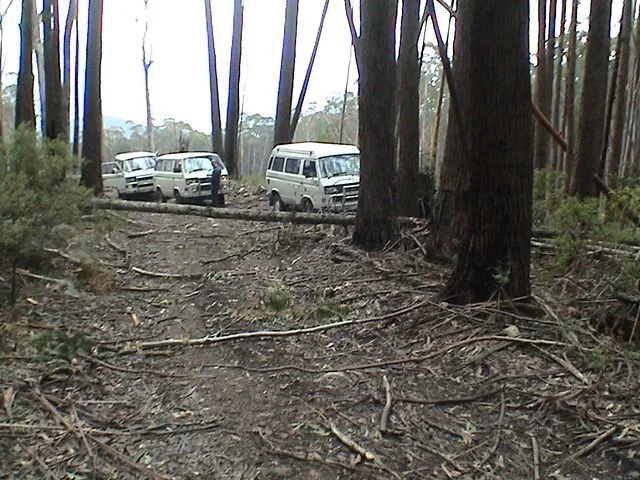
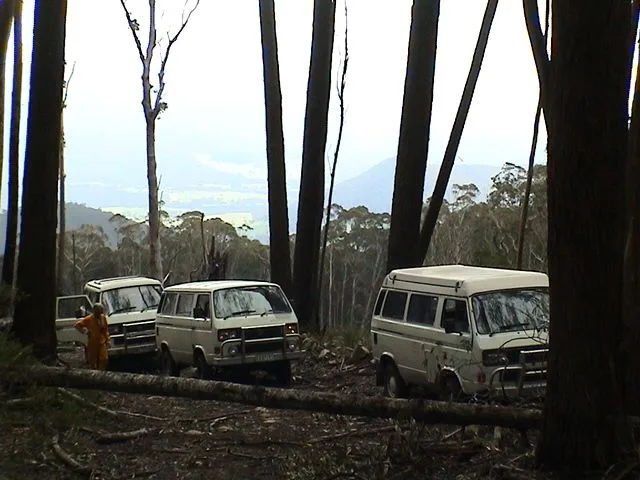
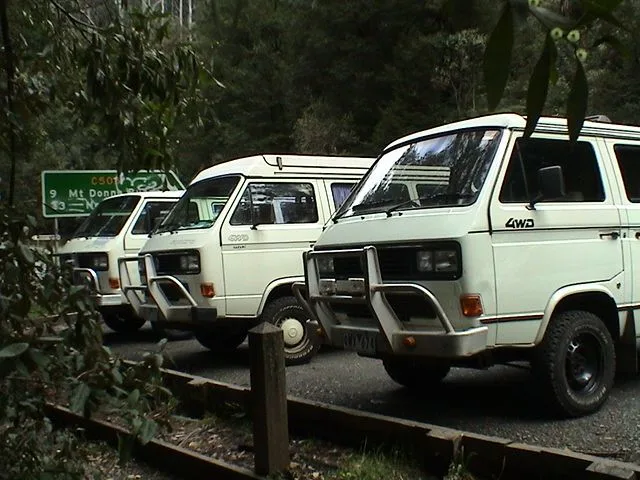
After a three-hour drive through the park along the ‘main tracks’ – which were more or less decent – we decided to turn off and head down towards the Cumberland River complex.
We had to cut down trees and fords three rivers, one of which was deep enough to reach the headlights, causing the van to float slightly when it lost traction on the riverbed. After four hours of muddy mess and hell on Jamieson Track, we decided, using the map, to take a new track to try and get back on course after realising things were getting worse by the minute. It was called Curtis Track.
It began with nearly 100 metres of soft mud where the vans sank up to their wheel arches. It took us nearly three hours to cross those 100 metres. At the end of it, we thought we’d see the light at the end of the tunnel, but it was quite the opposite. We came across a semi-firm track with a seemingly endless, constant climb, with gradients of up to 40 per cent in places. Neither the vans nor the DJ could cope with it. The tyres were completely clogged with fine, sticky mud, and it was becoming very dangerous because, when stopping or braking on the uphill section, the van’s weight and the lack of grip caused it to slide of its own accord towards a nearby ravine.
In a desperate attempt, I plucked up my courage and went for it, trying to get past what looked like the final bend towards a less dangerous section. A sharp right-hand bend with a steep gradient and deep ruts. The van got stuck halfway through the bend, stationary with all its wheels turning but making no headway. I realised there was no way out and tried to brake gently, hoping it would catch its footing with a slight upward incline. It worked and it stopped, but just then it began to slide diagonally backwards and to the left, straight towards the ravine. In that instant, I considered jumping out of the van and leaving it to its fate, hoping it would get stuck on a tree so I wouldn’t have to watch it fall. I pulled the handbrake and quickly opened the door to jump out, terrified, when suddenly the rear left wheel sank into a deep rut and the van was left on three wheels, with the one beneath me (the front right) hanging in the air. I realised at that very moment that if I got out of the cab, the loss of my weight would cause the van to tip over and plunge straight down the ravine. I shouted to Matthias, who, seeing the situation, like a young boar, hooked a rope round the structural bar and tied it to a tree, thus allowing me to escape and start thinking about how to get out of this mess.
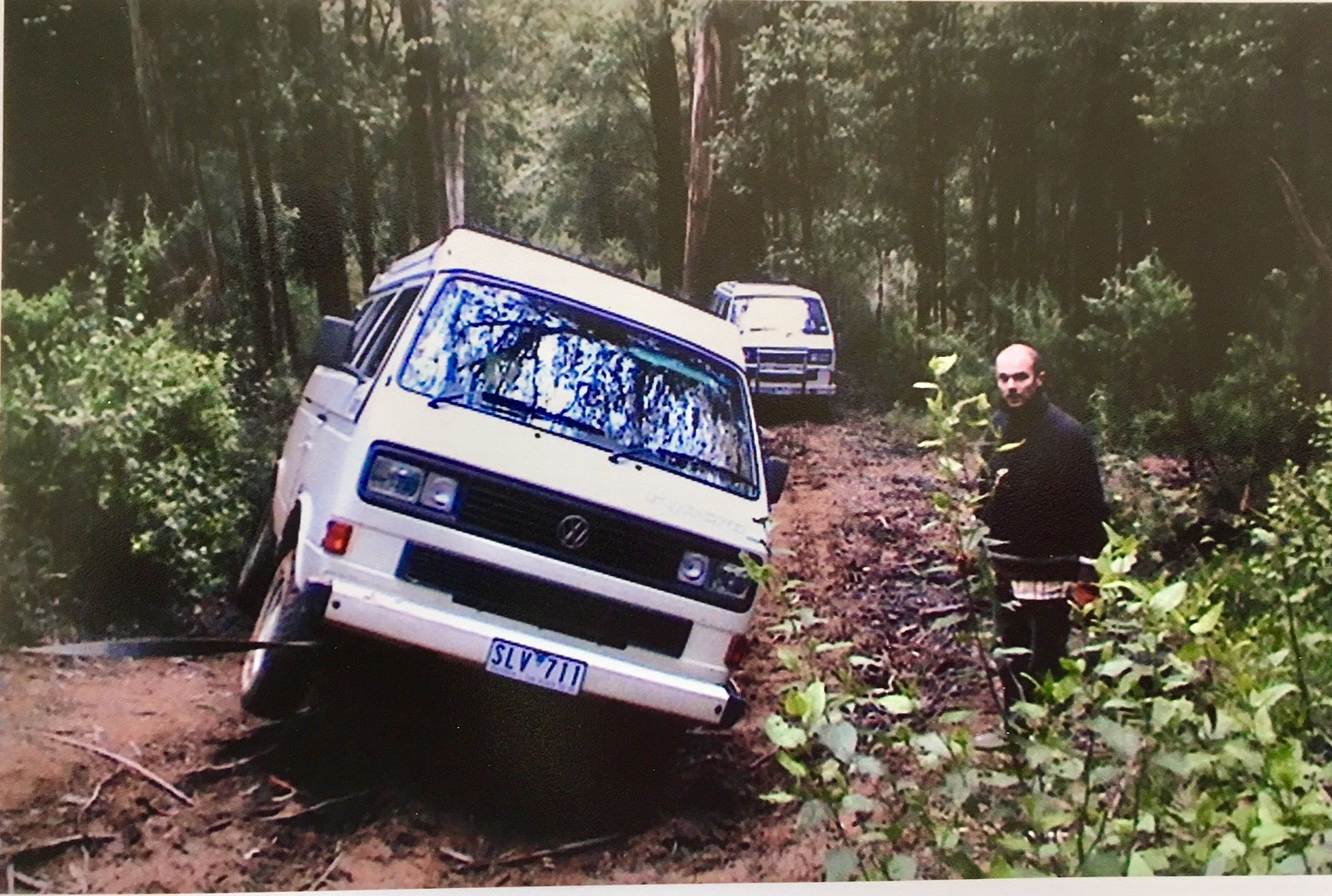
Seeing the situation, I wrote the van off as a lost cause, as in these parts there’s no assistance or help of any kind, and on other trips we’d seen many vehicles abandoned to their fate.
It was getting dark, we were already exhausted, we didn’t have much time left, and the mosquitoes were swarming all over us. The high-lift jack was sinking, and nothing else could be used, but Matthias had a ‘Rescue Balloon’ – one of those contraptions you attach to the exhaust pipe, which inflates a bag to lift the vehicle. It was our only chance. We dug like mad until we were completely worn out to free the wheel, and finally managed to inflate the bag. We filled the hole with rocks and clothes we’d brought in the van to prevent it from slipping. The van levelled out enough and, little by little, we freed the rear until we could control the van, which was also secured at the back with another winch. Well into the night, and by reversing, we managed to reach the muddy patch again. Exhausted and desperate, we ate, got drunk and cried to drown out the stress of what we’d been through. The next morning, we faced the muddy crossing again and returned along the track we’d originally come down, with our tails between our legs. That was the only time. Curtis Track got the better of us.
It
took us nearly three months to set out again, just to recover. Ever since then, whenever we mention Curtis Track, our eyes meet and strong emotions well up.
Years later, whilst travelling on Fraser Island (the world’s largest sand island), I also had a very stressful experience when the van got stuck in wet sand on a beach we had to cross to catch, at the very last minute, the only weekly ferry to the mainland, just as dusk was falling and the tide was rising rapidly, in an ocean teeming with tiger sharks (yes, the 5-metre ones that come into half a metre of water to catch you) and me with my 5- and 2-year-old children in the van!!! In an act of desperation, I engaged the wheel locks and started rocking the van back and forth. My children were screaming in fear, sensing the danger, whilst I was sweating buckets and imagining the worst. I really don’t know how I managed it, but we got out of there by some miracle.
On adventures of this calibre, you come to understand your own limitations and those of your vehicle, as well as its strengths. You come into direct contact with it, and an indescribable man-machine bond is forged.