
Batteries for camper vans: types, comparison and which one to choose
20 de marzo de 2025
The battery in my Volkswagen T4 California Exclusive has reached the end of its life. Before replacing it, I’ve decided to do some research into campervan batteries so I can make the best decision and choose the option that best suits my needs.
So, first of all, let’s look at:
What sort of battery do I have in my T4 California?
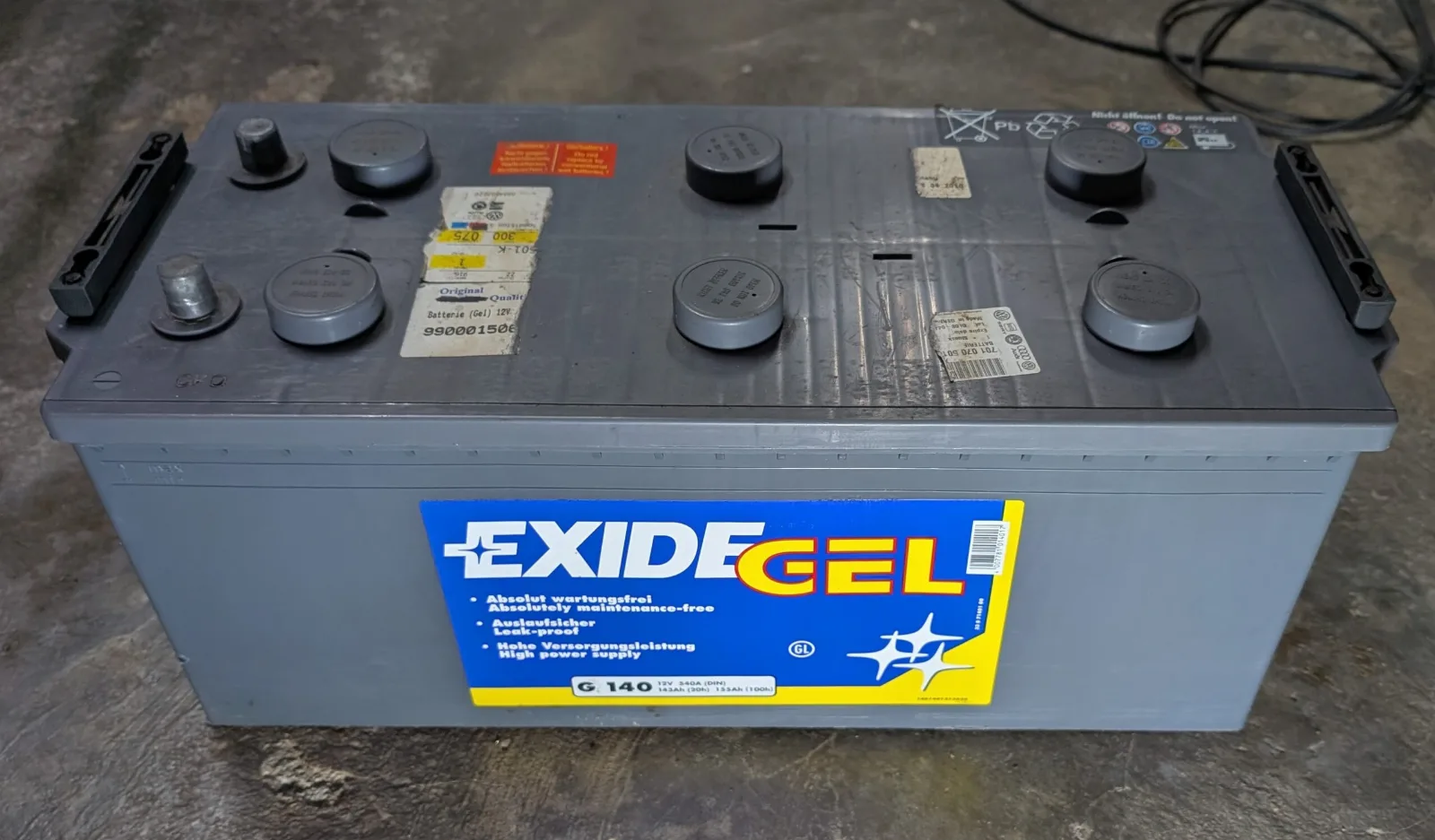
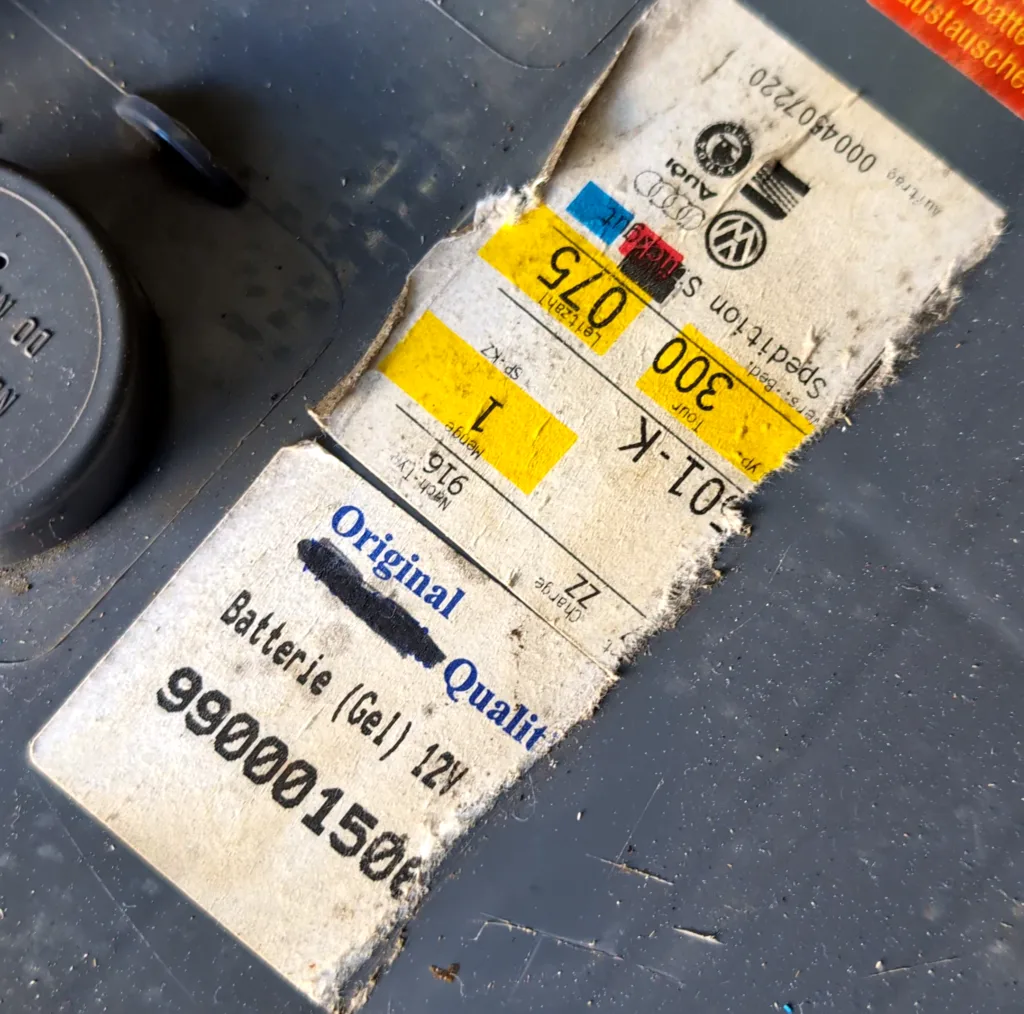
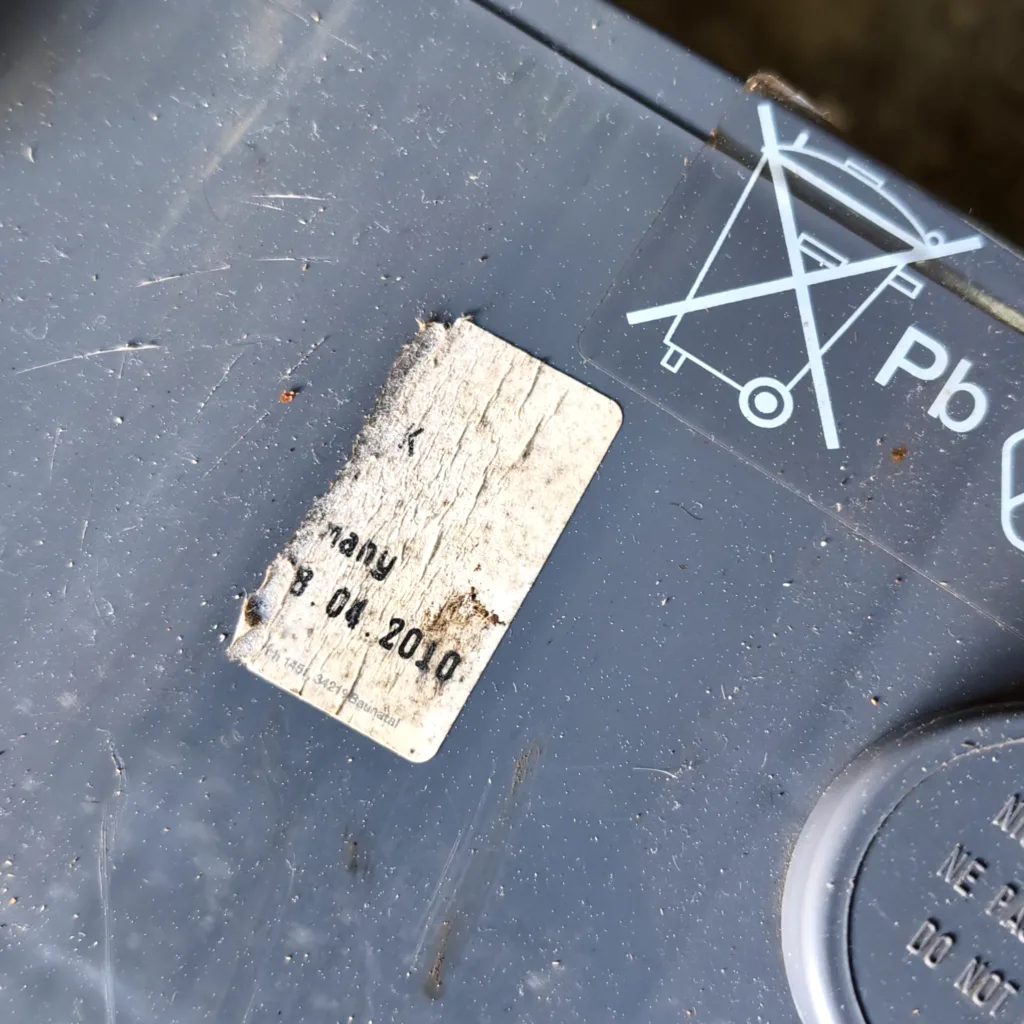
The auxiliary battery I have is a 140Ah GEL battery made by Exide. It measures 513x223x225mm and weighs 47.8kg. It’s interesting because the stickers on it state not only that it’s an original-quality battery but also that it dates from 2010 – in other words, it’s been in use for 15 years. That’s quite surprising for a GEL battery.
Current status of the auxiliary battery
The Volkswagen T4 California Exclusive has a control unit at the front from which various functions can be managed, and where you can view the charge status and voltage of the auxiliary battery. Well, recently it was showing this:
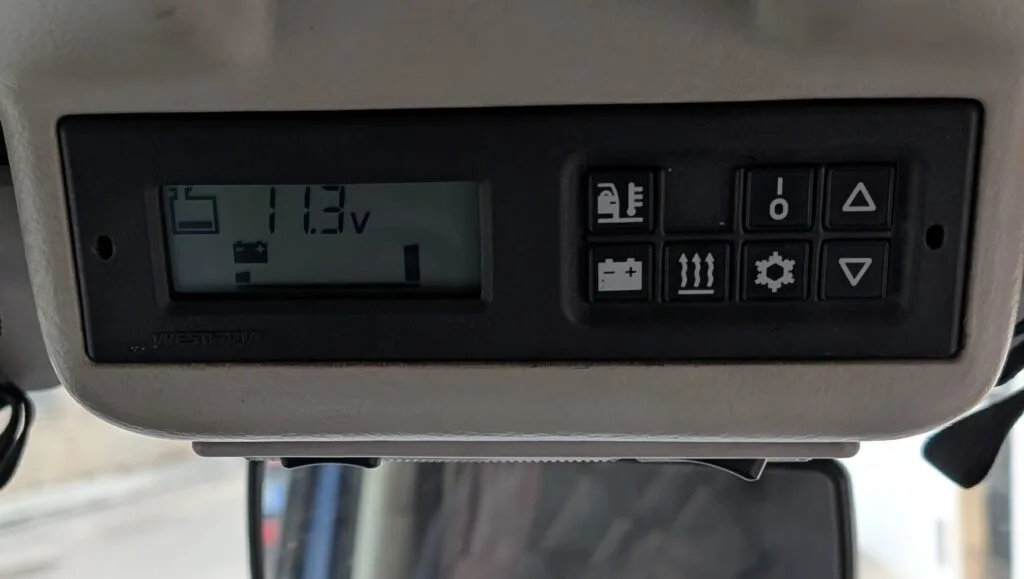
What does this mean?
It means that the battery is deeply discharged and in a critical condition. Normally, a battery of this type must be kept above 12.0V to prevent damage.
According to the voltage table:
- Fully charged: Approximately 12.8 to 13.2 V.
- Partially charged: Approximately 12.4 to 12.8 V.
- Medium discharge: Approximately 12.0 to 12.4 V.
- Deep discharge: Less than 11.8 V (this should be avoided to prevent damage to the battery).
In general, gel batteries should be kept above 12.0 V to prevent long-term damage. If the battery drops below this threshold, it is advisable to recharge it as soon as possible.
Types of batteries for camper vans
There are a number of factors to bear in mind regarding auxiliary batteries. One of these is that, depending on the technology, some batteries allow for more charge cycles whilst others allow for fewer; another consideration is the weight of the batteries; and a further factor is the permitted depth of discharge, as this affects the battery’s lifespan. And, of course, price is another factor to bear in mind.
Let’s now look at the types of technology used in campervan batteries. Basically, and to summarise, you can fit AGM, GEL, AGM/GEL hybrid, carbon GEL and LiFePO₄ batteries.
AGM batteries
These are sealed, maintenance-free batteries that can be installed in any position. They are cheaper than GEL batteries and offer an acceptable discharge capacity, but their service life is shorter.
- Life cycles: 300–1,000 cycles.
- Recommended depth of discharge: 50–70% (with a 200Ah battery, between 100Ah and 140Ah can be used before recharging).
- Charging time: Medium.
- Weight: 60–65 kg (200 Ah).
- Initial cost: Low.
- Long-term cost: Medium-high (due to frequent replacements).
GEL batteries
These use a silica gel electrolyte, which makes them more resistant to deep discharges and vibrations. However, they take longer to charge and do not cope well with very high charging currents.
- Cycle life: 500–1,500 cycles.
- Recommended depth of discharge: 50–80 per cent (with a 200Ah battery, between 100Ah and 160Ah can be used before recharging).
- Charging time: Slow.
- Weight: 55–60 kg (200 Ah).
- Initial cost: Medium.
- Long-term cost: Medium.
AGM/GEL hybrid batteries
These combine the advantages of AGM and GEL technologies to provide a balance between durability, efficiency and resistance to deep discharges. They are a good intermediate option for those seeking improved performance without moving up to lithium batteries.
- Cycle life: 700–1,500 cycles.
- Recommended depth of discharge: 50–80% (with a 200Ah battery, between 100Ah and 160Ah can be used before recharging).
- Charging time: Medium.
- Weight: 60–65 kg (200Ah).
- Initial cost: Medium to high.
- Long-term cost: Medium.
Carbon GEL batteries
These are an evolution of GEL batteries, enhanced by the incorporation of carbon into the negative plates. This technology reduces sulphation, improves charging speed and allows for deep discharges without affecting service life. They are an excellent option for those looking to improve performance without making the full switch to lithium batteries.
- Cycle life: 1,500–3,000 cycles.
- Recommended depth of discharge: 60–80% (with a 200Ah battery, between 120Ah and 160Ah can be used before recharging).
- Charging time: Medium-fast.
- Weight: 45 kg (200Ah).
- Initial cost: High.
- Long-term cost: Low.
LiFePO4 (Lithium Iron Phosphate) batteries
These are the best option in terms of efficiency, durability and lightness. They allow deep discharges without affecting their service life and offer fast charging times. Their main drawback is the high initial cost and the need to adapt the electrical system with a DC-DC booster and a compatible charger.
- Cycle life: 3,000–5,000 cycles.
- Recommended depth of discharge: 90–100% (with a 200Ah battery, between 180Ah and 200Ah can be used before recharging).
- Charging time: Fast.
- Weight: 20–25 kg (200 Ah).
- Initial cost: Very high.
- Long-term cost: Very low.
Comparison table: types of batteries for camper vans
| AGM | GEL | AGM/GEL | Carbon-GEL | LiFePO₄ | |
| Cycle life | 300–1,000 | 500–1,500 | 700–1,500 | 1,500–3,000 | 3,000–5,000 |
| Recommended discharge depth | 50–70% | 50–80% | 50–80% | 60–80% | 90–100% |
| Weight (200Ah) | 60–65 kg | 55–60 kg | 60–65 kg | approx. 45 kg | approx. 20 kg |
| Charging time | Medium | Slow | Medium | Medium-fast | Fast |
| Initial cost | Low (€) | Medium (€€) | Medium-high (€€€) | High (€€€) | Very high (€€€€) |
| Long-term cost | Upper-medium (replacement) | Medium | Medium | Low | Very low (lasts for more years) |
Power consumption
The second factor to consider when deciding which battery to fit in your campervan is your power consumption. This can determine both the amperage you’ll need and the technology that’s best for you.
In my case, these are the main energy-consuming appliances:
- RC-1140-1 fridge: 42W, with an average consumption of 3.5A/h at 12V. If the compressor runs 40% of the time, daily consumption is 33.6Ah/day.
- Water pump: Intermittent use, very low power consumption.
- Cabin lights: Low energy demand.
- Stationary heating: Depending on usage, consumption can vary between 10–15 Ah per night.
Charging methods
Another aspect to consider is how you will charge the auxiliary battery. There are three possible methods:
- Charging via the alternator: Whilst the engine is running, the alternator charges the secondary battery. A DC-DC booster is recommended to regulate the charging voltage and prevent overcharging or inefficiencies.
- Charging via solar panels: These allow for autonomous recharging when the van is parked. The use of an MPPT regulator is recommended, as it optimises charging efficiency and extends the battery’s lifespan.
- Charging via a 220V connection: Using a dedicated charger, the battery can be connected to the mains at campsites or at home for a full, controlled charge.
Conclusion on campervan batteries: what is the best option?
During my research, I’ve changed my mind several times, discovering new technologies and gaining a better understanding of those I was already familiar with.
So, based on the information I had initially, I ruled out LifePo4 batteries because:
- I believed there was a risk of explosion and fire with this type of battery.
- They were very expensive
- I would have had to replace my existing charger as it isn’t compatible with LifePo4
- I needed a booster to charge via the alternator
Therefore, in my view, it would have required a significant financial outlay and, on top of that, it was the most dangerous option. I was also aware of cheaper LiFePO4 batteries available on AliExpress, which gave me (and still gives me) little confidence.
My plan, then, was to stick with AGM and GEL. Technology evolves, and I began to discover hybrid AGM/GEL solutions and Carbon GEL. So I ruled out the more conventional options and focused on these last two. Carbon GEL was the option that appealed to me most, due to its longer cycle life and affordable price. What’s more, I didn’t need to buy a booster or change the charger, which made installation easier. However, I had to combine it with a solar panel and an MPPT regulator to prevent deep discharges. I knew the weight would be considerable, especially if I opted for a higher-capacity battery, and that the solar panel would also add to the weight.
But then I carried on learning and realised that within the lithium category there are various chemistries with different safety levels. Some carry a higher risk of fire or explosion, whilst others are much more stable. For example, NMC, LCO and NCA batteries are dangerous, whereas LifePo4 (LFP) and LTO are not.
I also found a charger that combined a booster function with a 220V charger and even solar charging with built-in MPPT. It wasn’t cheap, but combining those three functions worked out cheaper than buying them separately.
And finally, I found a LifePo4 battery that met my requirements in terms of price, amperage and safety.
My chosen ideal setup
The thing is, whilst browsing the internet and researching Carbon GEL batteries, I came across a brand called Upower which had good products at a reasonable price. That’s when I looked into the lithium options they offered. There were capacities of 120Ah, 150Ah and 200Ah – the range that suited me – and I saw that they were sold not only on specialist websites but also in large retail chains such as El Corte Inglés and Leroy Merlin.
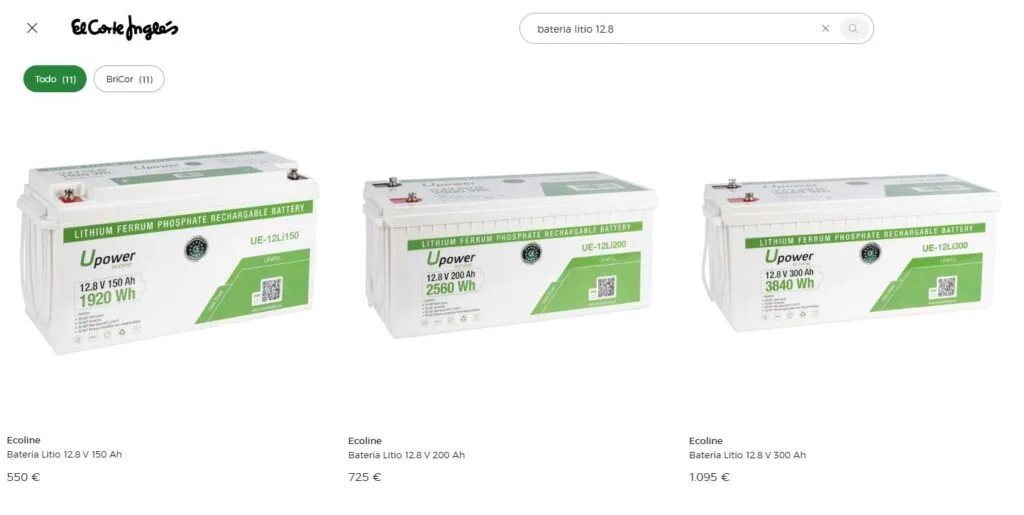
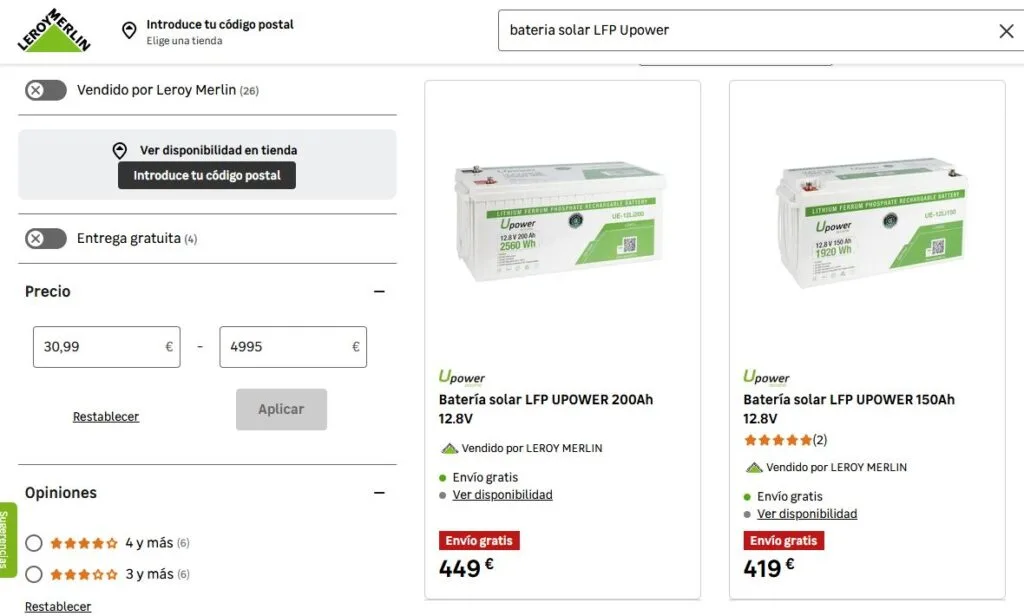
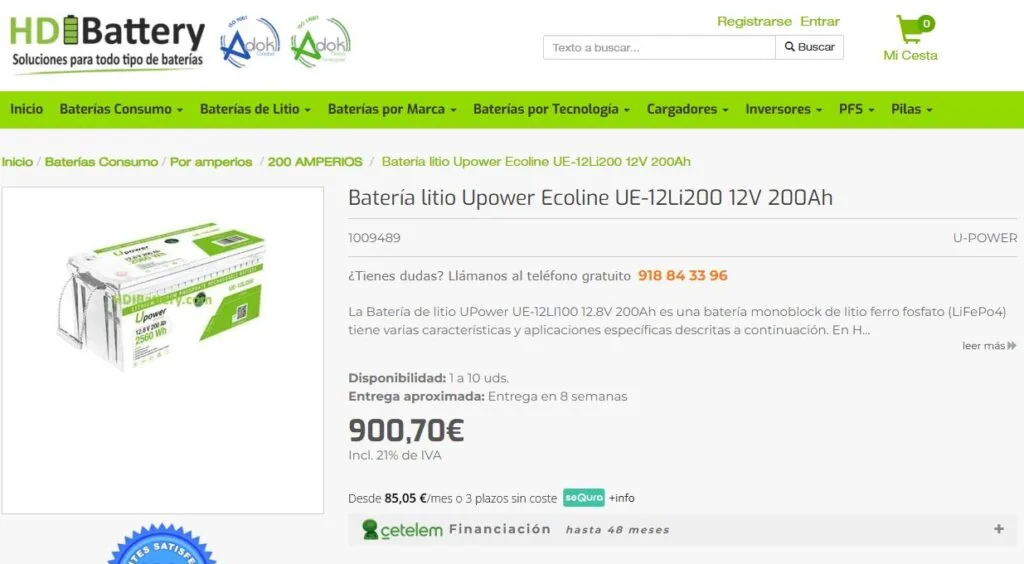
If you’ve noticed, the price difference between El Corte Inglés and the UPOWER 200Ah 12.8V LFP solar battery at Leroy Merlin is striking. At Leroy Merlin, for 449 euros, you could get a 200Ah lithium battery. It’s interesting because on other websites it’s also priced high or very high, with prices reaching as much as 900 euros.
Upower LFP 200Ah LiFePO4 battery at Leroy Merlin
It’s a 200Ah battery, which will be more than enough for my needs. As I said, I bought it from Leroy Merlin, so I can be sure it complies with European CE standards, comes with a 3-year warranty, is from a brand with quality certifications, and has a built-in BMS (which is crucial for maintaining the battery’s safety, efficiency and longevity) and is priced similarly to other technologies. I gain more charge cycles and save a lot of weight (it weighs just 19.5 kg).
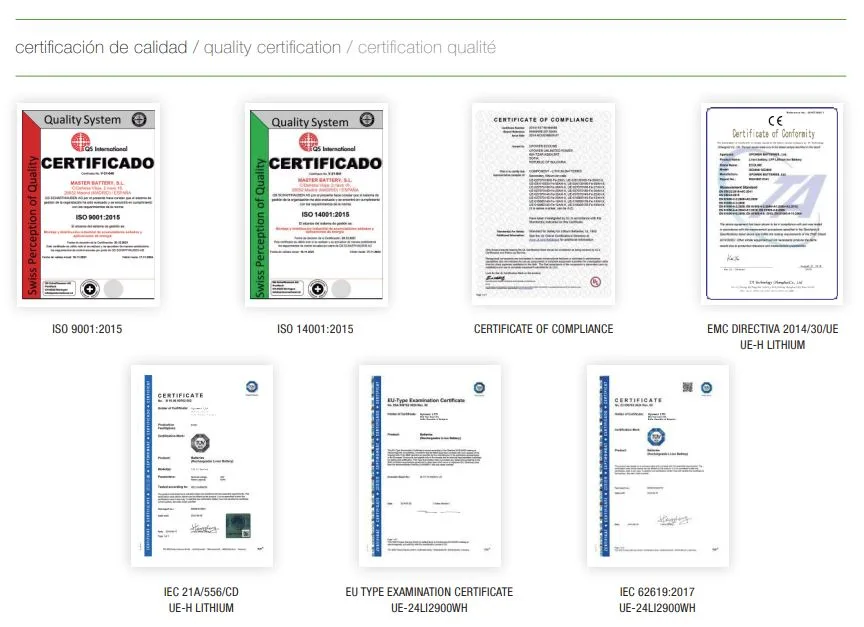
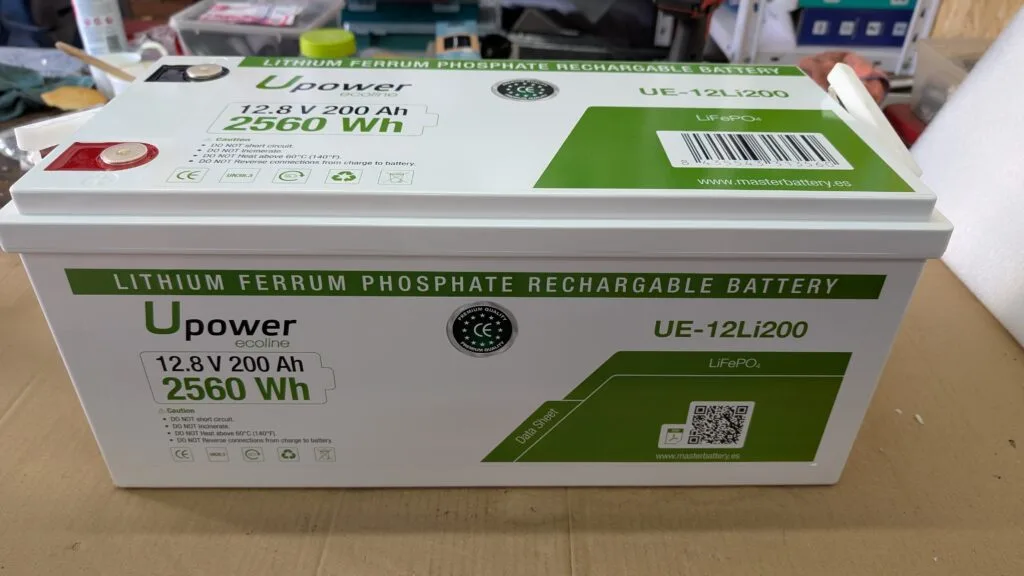
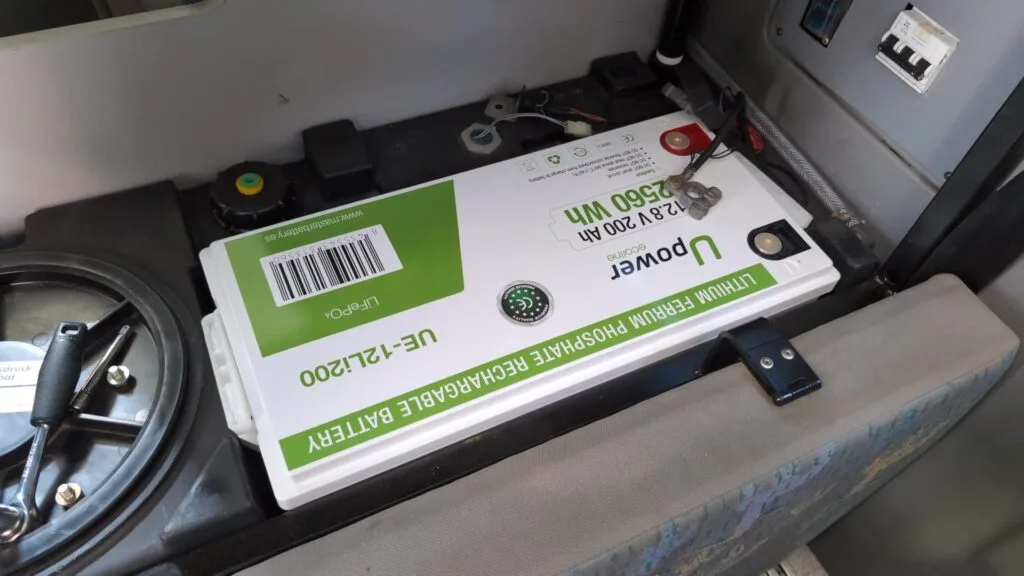
Given the price, the guarantees of buying it from Leroy Merlin and Upower’s quality certificates, there was no doubt that it was the best option.
⚠️ UPDATE (June 2026): The battery I bought back then has been upgraded. The model currently available at Leroy Merlin is the Upower Ecoline 200Ah 12.8V with Bluetooth, which features mobile monitoring (voltage, capacity, SOC and temperature) and weighs 24.5 kg according to the manufacturer. The current price is 459 euros. View the Upower Ecoline 200Ah battery at Leroy Merlin.
However, there was still the issue to resolve that if I switched to lithium, I’d have to change the charger and fit the booster.
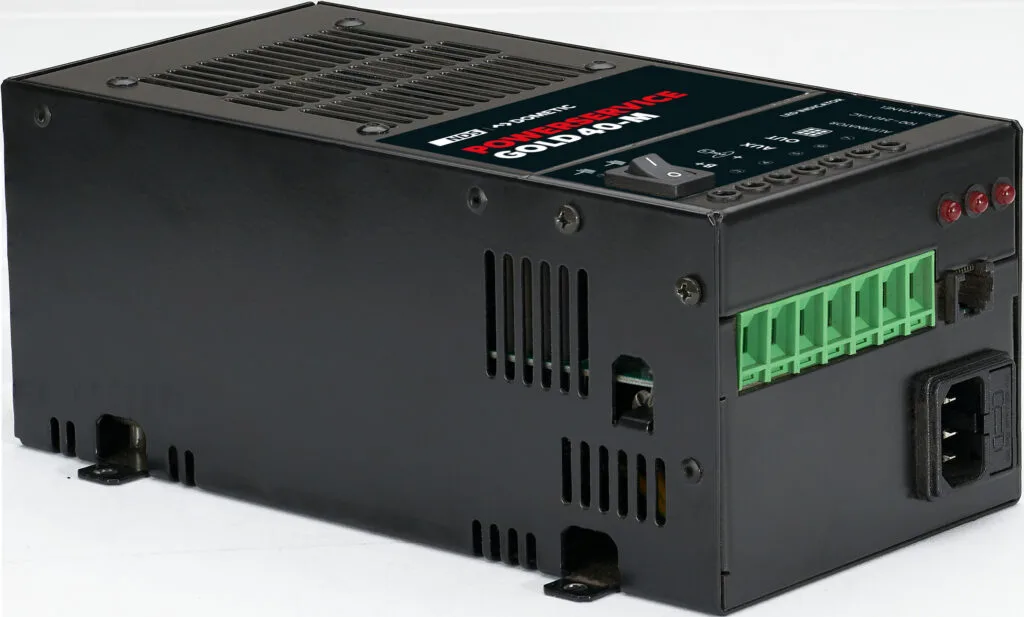
NDS Power Service Gold 40-M
This is the device I mentioned earlier; it serves as a 220V 20A charger, a 40A booster and a 20A solar charger. It costs 430 euros, which makes the setup more expensive, but I found it on Wallapop at a very good price. What’s more, my plan is to sell my old Philips PE 2169/02 charger and recoup some of the money.
Finally, it’s worth bearing in mind that with LiFePO₄ I save myself the hassle of installing a solar panel, which comes at a cost, requires fitting, can affect aerodynamics, needs to be type-approved if fixed in place, and adds extra weight. And I say I’m saving myself all this because, with LiFePO4 and the fact that it can be discharged so deeply, I won’t need it.
With these two components, I already have a very good setup that will last me many years and won’t leave me without power.